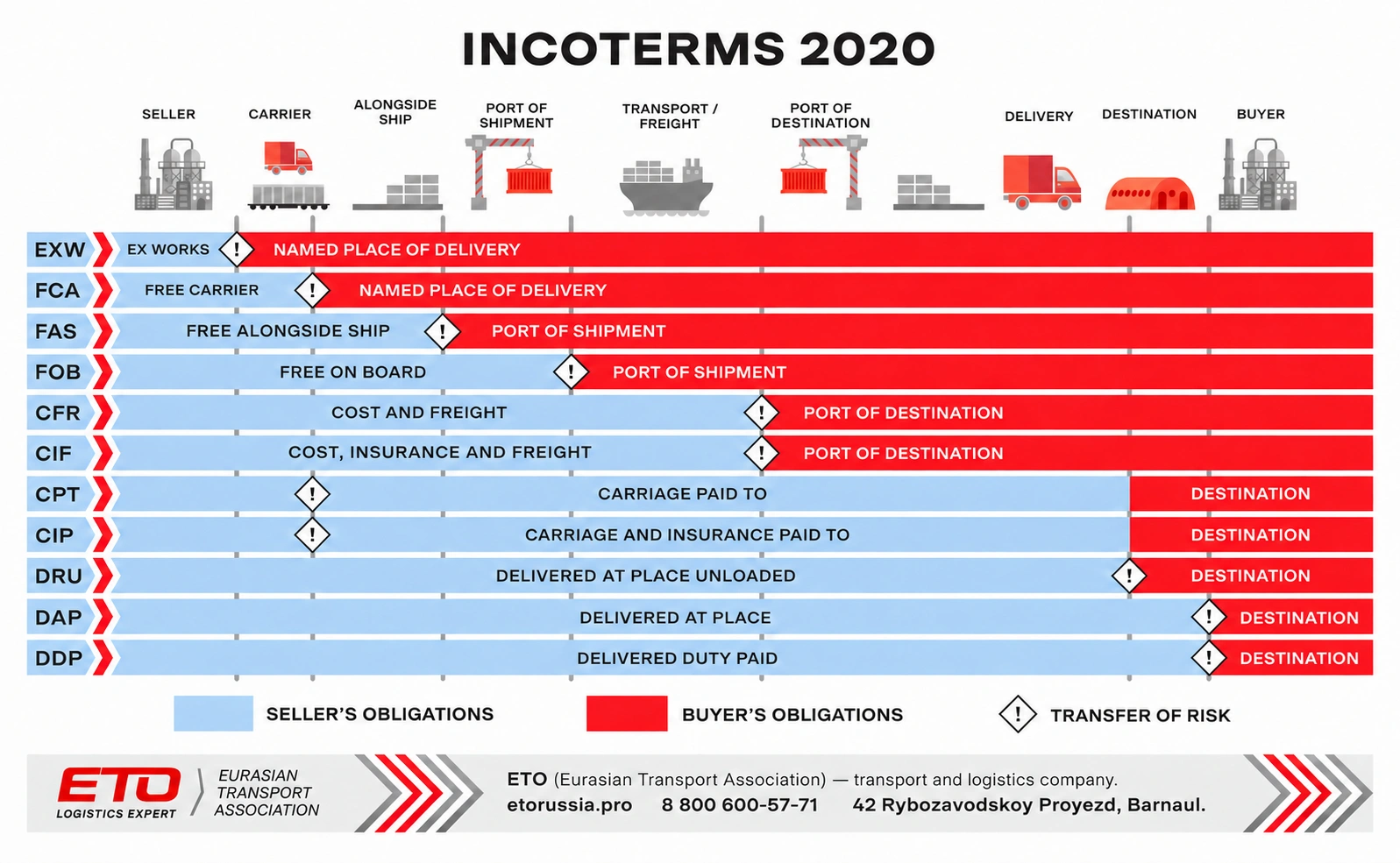
INCOTERMS (International Commercial Terms) are unified international rules recognised by state customs authorities, legal companies and merchants all over the world. They define the rights and obligations of the parties under a sale and purchase contract with regard to the delivery of the goods from the seller to the buyer.
The most important thing that Incoterms regulate is the moment of transfer of risk of loss or damage of the goods, as well as the allocation of the costs of transportation, insurance and customs clearance.
Group E - Departure (minimum obligations for the seller):
The seller is considered to have fulfilled his obligations when he places the goods at the buyer's disposal at his own premises (warehouse, plant). The seller is not responsible for loading the goods onto the vehicle or for customs clearance for export. The buyer bears all risks and costs of removing the goods from the seller's territory to the place of destination.
Group F - Main carriage unpaid:
The seller delivers the goods, cleared for export, to the carrier nominated by the buyer at the named place. Risks transfer at the moment the goods are handed over to the carrier. Payment for the main carriage rests with the buyer.
Used only for sea and inland waterway transport. The seller completes the delivery when the goods pass over the ship's rail (loaded on board) at the named port of shipment. The risk of loss or damage of the goods transfers to the buyer from that moment.
Group C - Main carriage paid by the seller (but risks transfer earlier):
Only for sea transport. The seller must pay the costs and freight necessary to bring the goods to the named port of destination. HOWEVER, the risk of loss or damage of the goods transfers to the buyer as soon as the goods are loaded on board the vessel at the port of shipment.
Similar to CFR, but the seller must also arrange and pay for marine insurance against the risks of loss of the goods during carriage for the benefit of the buyer.
A universal term. The seller pays the freight for the carriage of the goods to the named place of destination. Risks transfer to the buyer when the goods are handed over to the first carrier.
The same as CPT, but with the seller's obligation to insure the cargo.
Group D - Arrival (maximum obligations for the seller):
The seller completes the delivery when the goods are placed at the buyer's disposal on the arriving vehicle, ready for unloading at the named place of destination. The seller bears all risks associated with delivery to that place. Import customs clearance rests with the buyer.
Maximum obligations of the seller. He bears all costs and risks up to the place of destination, including the payment of import duties, taxes and charges. The goods are delivered cleared for import and ready for unloading.
The choice of a particular term depends on the agreements of the parties, logistics capabilities and the willingness to take responsibility for transit risks. When concluding international contracts, the year of the edition of the rules should always be indicated, for example "Incoterms 2010" or "Incoterms 2020".